
Quick answer
In this comparison, the electric car is cheaper in 22 of 26 cantons. In some cantons, the petrol car clearly wins.
The reason is simple: an EV has no displacement and no tailpipe CO2, but the battery adds weight. Swiss cantons treat these factors very differently.
Why these two cars?
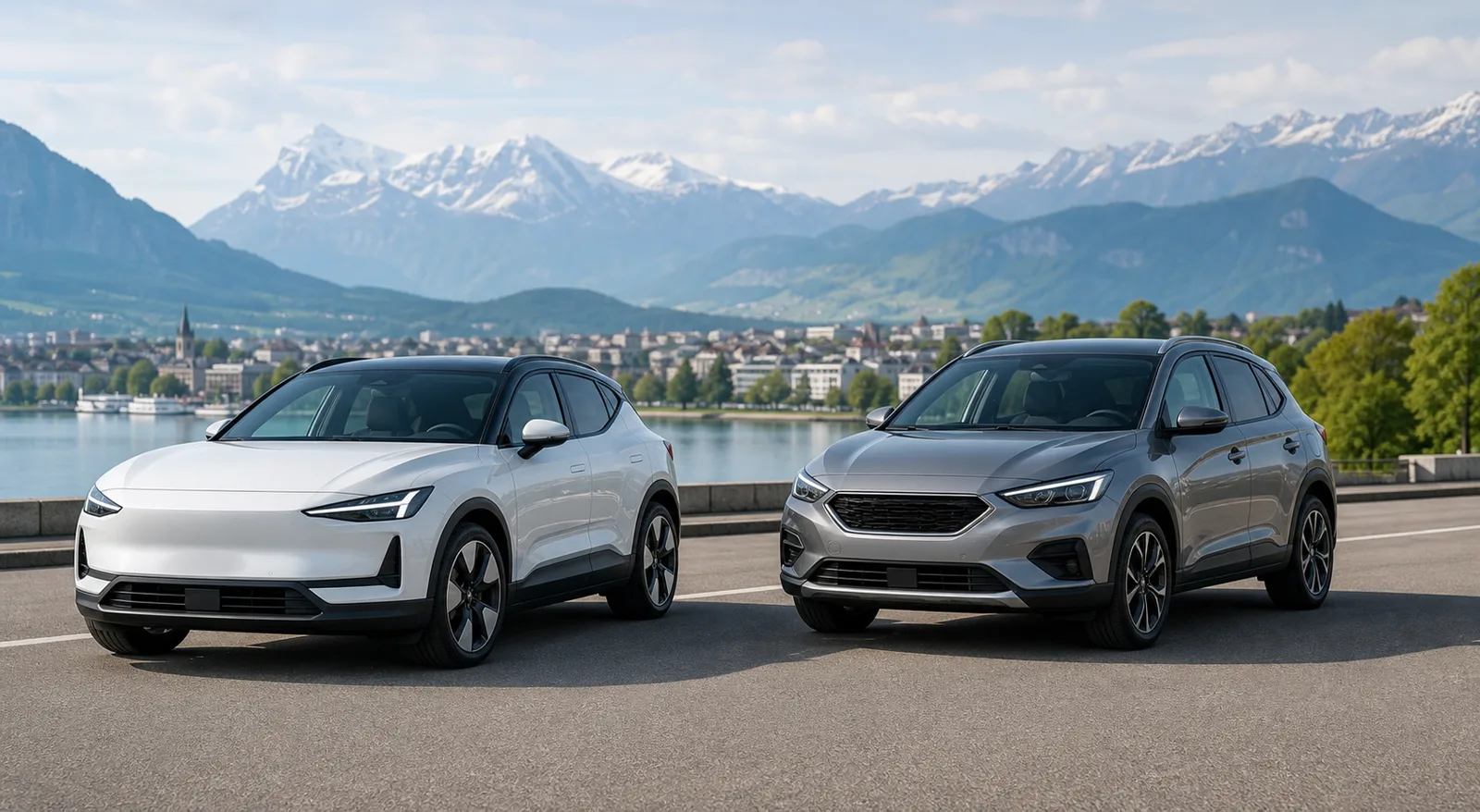
Tesla Model Y Long Range AWD
Electric family SUV
The Model Y is a very visible Swiss EV: family-friendly, heavy enough to show canton weight rules, and a useful test case for EV reductions.
- about 1,995 kg curb weight
- about 2,619 kg gross weight
- 153 kW tax-relevant power
- 0 g/km CO2
VW Tiguan 1.5 eTSI
Petrol mild-hybrid family SUV
The Tiguan is a practical petrol comparison: similar family-SUV use case, but with displacement, CO2 and lower weight.
- about 1,630 kg curb weight
- about 2,130 kg gross weight
- about 145 g/km CO2
- 1,498 cc displacement
Canton by canton: estimated annual tax
The chart shows the estimated annual tax for both example cars. Green is the EV, grey is the petrol car. Values are rounded.
What the numbers show
The Tesla performs well in cantons with EV reductions or CO2/displacement-heavy formulas. Bern, Basel-Stadt, Glarus, Solothurn and Grisons stand out.
The Tiguan wins where gross weight matters strongly and EV benefits are limited. In this example that mainly affects Appenzell Innerrhoden, Appenzell Ausserrhoden, Geneva and Schwyz.
Aargau, Zug, Ticino, St. Gallen and Vaud are close. A different trim or gross weight can change the result.
Why weight matters
Batteries make electric cars heavier. A family EV can weigh 300 to 600 kg more than a similar petrol car.
Depending on the canton, tax can use curb weight, gross weight, power, displacement, CO2, energy label or drive type.
So the real question is not only EV versus petrol, but the exact Swiss type approval values.
Why every canton is different
Motor vehicle tax is cantonal. Some cantons strongly support EVs; others calculate mainly with technical values.
That is why a serious comparison needs the canton and the exact vehicle version.
All cantons compared
| Canton | Electric car | Petrol car | Difference |
|---|---|---|---|
| ZH Zurich | CHF 0 | CHF 298 | -CHF 298 |
| BE Bern | CHF 111 | CHF 470 | -CHF 358 |
| AG Aargau | CHF 286 | CHF 292 | CHF 6 |
| BS Basel-Stadt | CHF 125 | CHF 436 | -CHF 311 |
| BL Basel-Landschaft | CHF 456 | CHF 615 | -CHF 159 |
| SO Solothurn | CHF 0 | CHF 317 | -CHF 317 |
| TG Thurgau | CHF 48 | CHF 240 | -CHF 192 |
| VD Vaud | CHF 67 | CHF 208 | -CHF 141 |
| SG St. Gallen | CHF 335 | CHF 527 | -CHF 192 |
| GL Glarus | CHF 0 | CHF 322 | -CHF 322 |
| LU Lucerne | CHF 83 | CHF 399 | -CHF 316 |
| SH Schaffhausen | CHF 195 | CHF 204 | CHF 9 |
| SZ Schwyz | CHF 445 | CHF 334 | +CHF 111 |
| GR Grisons | CHF 111 | CHF 427 | -CHF 316 |
| FR Fribourg | CHF 276 | CHF 532 | -CHF 256 |
| NE Neuchâtel | CHF 250 | CHF 485 | -CHF 235 |
| JU Jura | CHF 423 | CHF 463 | -CHF 40 |
| OW Obwalden | CHF 125 | CHF 149 | -CHF 24 |
| NW Nidwalden | CHF 0 | CHF 133 | -CHF 133 |
| UR Uri | CHF 384 | CHF 469 | -CHF 84 |
| ZG Zug | CHF 260 | CHF 272 | CHF 12 |
| TI Ticino | CHF 230 | CHF 317 | -CHF 87 |
| VS Valais | CHF 180 | CHF 226 | -CHF 46 |
| GE Geneva | CHF 520 | CHF 301 | +CHF 219 |
| AR Appenzell Ausserrhoden | CHF 802 | CHF 638 | +CHF 164 |
| AI Appenzell Innerrhoden | CHF 686 | CHF 539 | +CHF 147 |
What to check before buying
- Calculate tax in your canton.
- Compare the exact version, not only the model name.
- Check whether EV reductions are temporary.
- Add insurance, energy, tyres, service and depreciation.
- Use the Swiss type approval value for more precise technical data.
Conclusion: EVs often win, but not automatically
For many Swiss households, an EV is attractive for vehicle tax. The benefit comes from cantonal rules, not from one national formula.
A heavy electric SUV can be more expensive in some cantons than a lighter petrol car. In CO2 or displacement cantons, the petrol car can lose clearly.
The useful answer is concrete: your car, your version, your canton.
Compare your own car
Estimate vehicle tax for your canton with a type approval number or manual input and compare the technical values.
Data and limits
The example uses typical Swiss technical vehicle data and AutoTyp tax rules. The formulas were cross-checked against the TCS 2026 canton tax benchmark and AutoScout24 buyer-cost guidance. For the electric car, the tax-relevant power from the vehicle document/type-approval context is used, not a marketing peak-power figure. Canton rules can change; the official canton invoice remains binding.
FAQ
Are electric cars always tax-free in Switzerland?
No. Some cantons reduce or waive tax, while others tax EVs by weight or power.
Why can an electric car be more expensive?
Mainly because of battery weight. If a canton taxes weight strongly, a heavy EV can cost more.
Are these values official?
No. AutoTyp provides an estimate. The official canton assessment or invoice is binding.